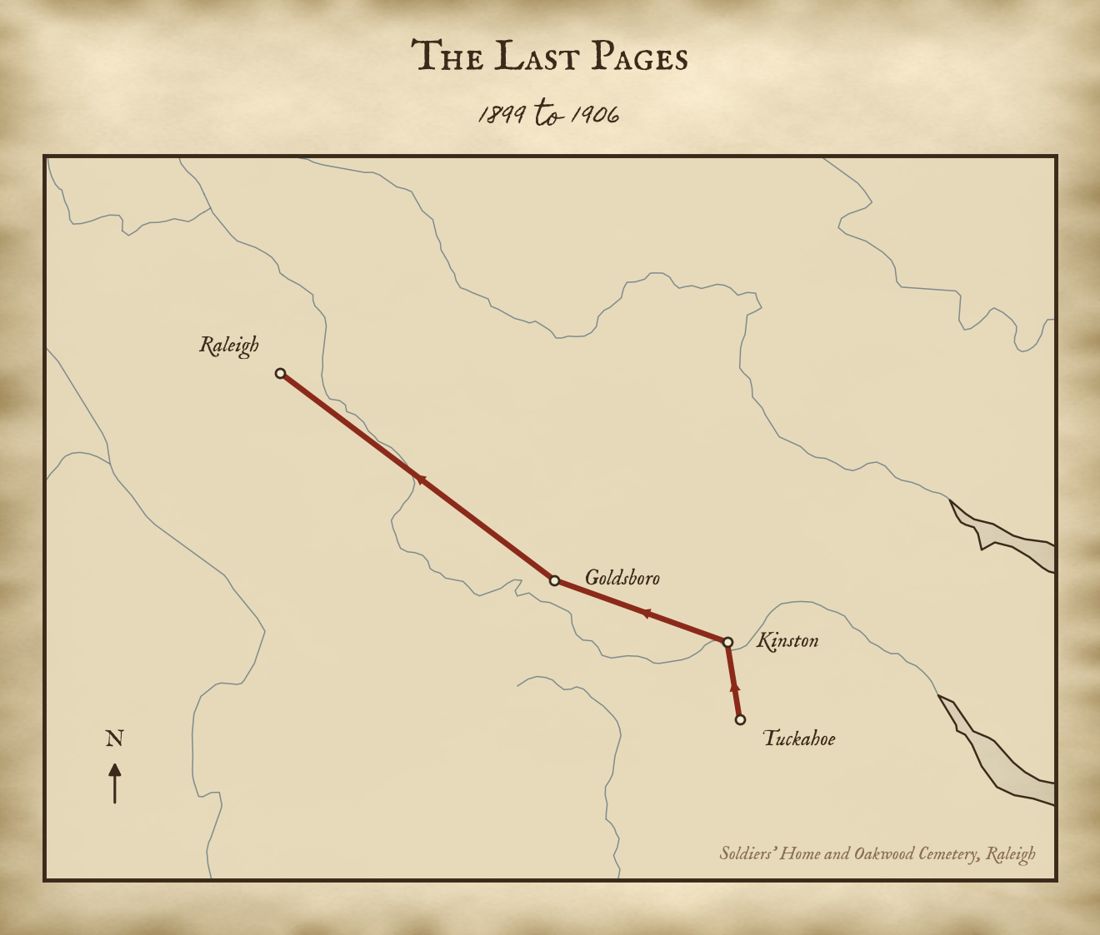
Chapter 18 of 18
The Last Pages
July 21, 1899 to December 1906
Lenoir County
July 21, 1899
Charlie found this book in the bottom of the trunk and brought it to me. I haven’t written in it in thirty-four year. My letters are big as a young’un’s now, for I can’t hardly see the line, but I mean to set this down.
I am seventy year old. The rupture I got in the war has got the best of me, and the old wounds, and plain old age on top. I can’t hoop a barrel no more. I can’t provide for myself, and I hate to be a load on my young’uns.
So today I went before Squire Smith and put in to be taken into the Soldiers’ Home up at Raleigh. Johnny Howard and Wendal Harper came and signed for me, swore they knew me in the 27th. Forty year gone and them boys still stood by me. The paper says I’m to stay at home till they send word.
Lenoir County
December 4, 1899
Word came. Not yet. They’ve put my name on a list and I’m to wait.
Forty year ago nobody made me wait to go and get shot.
I reckon there’s a heap of old soldiers ahead of me, and some worse off. But I sat a long time on the porch after Charlie read me that letter.
Kinston
June 8, 1901
I went before the clerk today to ask for the state pension. Dr. Pollock looked me over and wrote down the shoulder and the rupture and that my sight is near about gone. He told the clerk I ought to have the full pension. William Taylor stood up for me too.
I told ’em true where I was hit. Bristoe Station, in the right shoulder, the ball running along my back and out the left. It doesn’t feel like thirty-eight year ago some nights. It feels like last week.
I couldn’t see the line on their paper to sign my name, so I made my mark. These words here I’m putting down by feel, big as a barn door. I don’t know how much longer I can do even that.
Lenoir County
September 2, 1901
Sarah is gone. I don’t have it in me to write more about it than that.
I have put in for the Soldiers’ Home a second time. Henry Cunningham and J. P. Gray signed for me, both of us Company D. This time when they asked where I was at the end of the war, I told ’em the plain truth. I was in prison at Newport News. Two year ago I said Appomattox. I reckon I wanted to have been there with the boys so bad I near about believed it. An old man can be forgiven that, I hope.
I am old and feeble and nearly blind. I don’t know where else to go.
The Soldiers’ Home, Raleigh
November 1901
They have taken me in.
It’s a clean place with a good bed and three meals and old men in gray sitting on the porch telling their wars to one another. I can’t see their faces good, but I know the sound of a Tar Heel voice. One feller was at Sharpsburg too. We sat together and didn’t say much. We didn’t need to.
There’s a young lady comes on Thursdays to read the paper to the blind men, Miss Mary Ellen Hobbs, sixteen year old and bright as a new penny. I asked her would she write in this book for me, since I can’t no more. She said she’d be proud to. So from here on I’ll say it and she’ll set it down, and I told her not to fix my grammar none.
The entries that follow are written in a different hand. Mr. Freeman spoke them, and I wrote them down as near to his own words as I could. M. E. H.
The Soldiers’ Home, Raleigh
April 1902
The preacher came Sunday and read the Twenty-third Psalm to us old men in the chapel. Yea, though I walk through the valley of the shadow of death, I will fear no evil: for thou art with me.
I have walked that valley, Lord knows. Down that hill at Malvern. Across that field at Bristoe. I didn’t know then that He was with me. I thought I was alone with my rifle and my fear. But I came out the other side when better men didn’t, and I’ve been studying on why ever since.
I don’t reckon I’ll ever know the why of it this side of glory. But I believe He had His hand on me at that railroad bank. A ball through both shoulders and nary rib broke. That ain’t luck. It’s mercy.
The Soldiers’ Home, Raleigh
December 25, 1903
Christmas at the Home. They gave us oranges and a good dinner, and some ladies came and sang carols. I sat there with that orange in my hand and thought of Christmas of ’64 in the trenches at Petersburg, a little meal and coffee that wasn’t coffee, and the boys singing to keep from crying.
The preacher read from Luke. Glory to God in the highest, and on earth peace, good will toward men.
Peace on earth. I saw precious little of it in my life. But I believe it’s coming, not by men’s hands, for I saw what men’s hands can do. It’s coming by His.
The Soldiers’ Home, Raleigh
October 1904
I have been thinking on forgiving.
Forgive us our debts, as we forgive our debtors. I have said them words all my life and not always meant ’em. I have carried a grudge against the Yankees for forty year. Against the men that sent us across that field at Bristoe. Against my own self for running at New Bern.
But there was a Yankee at Newport News that saw this very book in my shirt and looked away and let me keep it. There was a woman at a gate that gave me cornbread and asked me nothing. God put kindness in the road for me on both sides of that war.
And I have thought on the colored folks I saw in New Bern in ’65, walking free and not trusting us. I didn’t understand it then. I am an old man now and I believe the Lord made every soul of us, and I reckon I see some things clearer with these blind eyes than I did with good ones.
I am laying the grudges down. They’re too heavy to tote where I’m going.
The Soldiers’ Home, Raleigh
May 10, 1905
Memorial Day. They carried us that could walk over to Oakwood, where the boys that died in the hospitals here is buried in rows. Ladies put flowers on every grave. I couldn’t see the stones, but I could smell the flowers and hear the names read out.
I reckon I’ll lay there my own self before long. I don’t mind. I’d as soon be amongst soldiers.
I kept hearing Hardy’s name in my head, and Davis, and the ones that never got a stone at all, just a ditch in Maryland. The Book says In my Father’s house are many mansions. I believe them boys have got a room there. I believe I’ll see ’em. And I believe they’ll be whole, every one, not a hole in ’em.
The Soldiers’ Home, Raleigh
March 1906
The chaplain read to me from Paul. I have fought a good fight, I have finished my course, I have kept the faith.
I ain’t sure all the fights I fought were good ones. That’s for the Lord to judge, not me. But I have finished my course, or near about. And I have kept the faith, poor as mine has been some days.
What lies ahead don’t scare me. God shall wipe away all tears from their eyes; and there shall be no more death, neither sorrow, nor crying, neither shall there be any more pain. No more pain. Lord, I have wanted to hear that for forty-two year. No more shoulder. No more rupture. Eyes that can see.
I reckon the first thing I’ll see with my new eyes will be His face. And then maybe Sarah’s, standing in the door.
The Soldiers’ Home, Raleigh
December 1906
Mary Ellen has to lean close to hear me now. My voice is about given out like my eyes. But I know my time is close, the way a man knows rain is coming before the first drop.
I ain’t afraid. I’ve been closer to dying than this, at a rail fence and a railroad bank and a hundred places in between.
I think about the Tuckahoe boys a heap. Hardy and Davis and all those that never came home. I think about Sarah standing in the door. I think about the barrels I made, every stave leaning on the next one.
If this is my last line, Lord, receive me.
I did the best I knew how.
Mr. Freeman passed a few days after he gave me those last words. He asked that this book go to his son Charlie, and I have sent it to him with my prayers. I never knew a gentler man. M. E. H.
Maps from the printed book