Chapter 17 of 18
Home, But Not Whole
July 6, 1865 to September 3, 1865
Tuckahoe, Lenoir County
July 6, 1865
I walked the last stretch slow, and not from being careful.
A man carries home in his head like a picture in a frame that never changes. But the yard is littler than I remembered. The fence leans like an old drunk. The field has that wore-out look, worked too hard by too few hands.
Sarah saw me from the door. She didn’t holler and she didn’t run. She just put her hand over her mouth and stood there, and then she came down the steps. William is six years old now and shot up like a weed, looking at me like I’m a stranger, which I reckon I am. Loary hid behind her mama’s skirt.
I couldn’t pick neither one of ’em up. My shoulder wouldn’t let me. I got down on my knees in the dirt instead.
Tuckahoe, Lenoir County
July 15, 1865
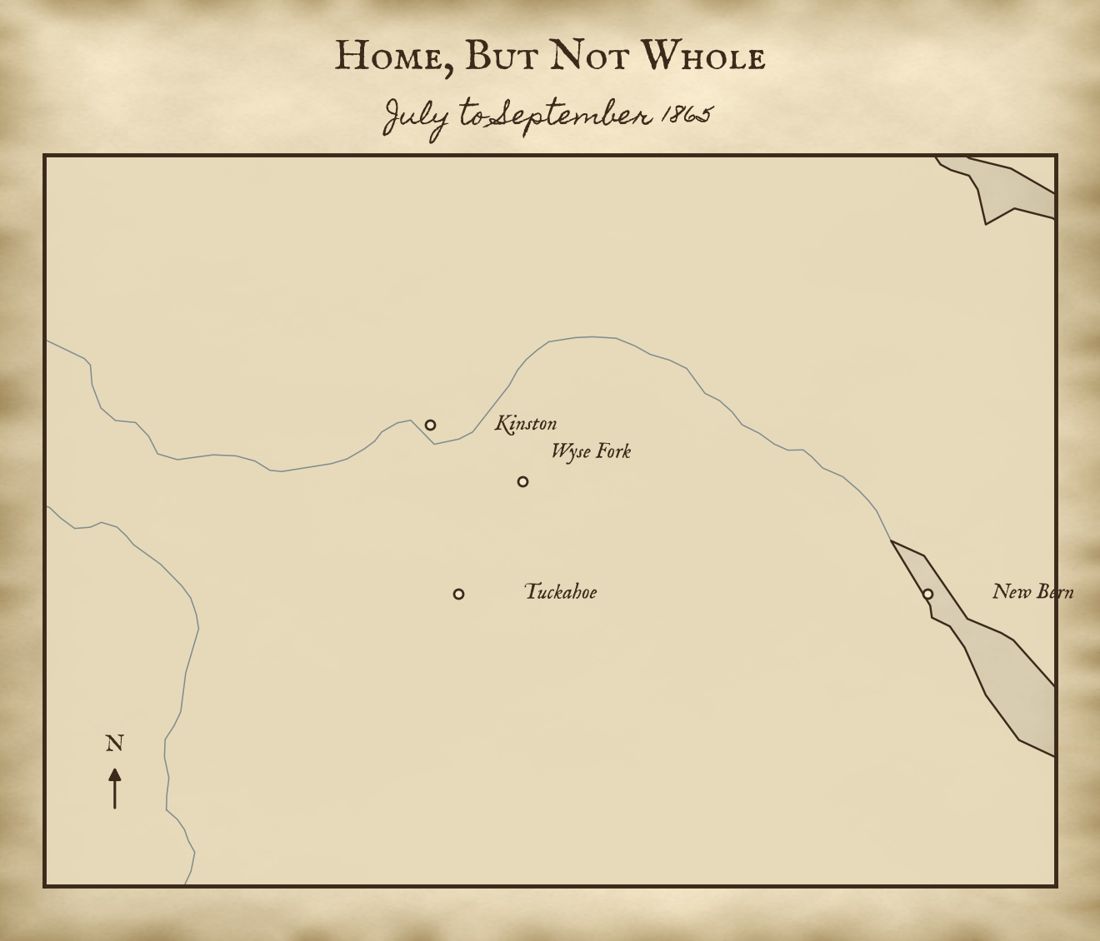
There’s men around Kinston that speaks low about February of ’64. I asked an old neighbor about it and he just shook his head and said, “Don’t go stirring that mud.” But mud has a smell, and it rises when you step close. There were hangings in Kinston that winter, men accused of going over to the Yankees. Some call it justice. Some call it fear in a uniform. It left a scar on this county that Lee’s surrender didn’t heal.
And in March the war came right through here again. Big fighting down at Wyse Fork, below Kinston, and the Yankees through the town after. Folks point toward the river and say, “They come through yonder,” like Union soldiers were a storm that broke trees and took what it wanted.
The war didn’t end clean. It broke off jagged.
The cooper’s shed
August 1, 1865
I told myself on that boat and on them roads that I’d go back to my hands, to staves and hoops and barrels. Work I understand.
But the hands I brought home ain’t the hands I left with.
My right shoulder is stiff of a morning like it’s full of cold iron. My eyes are worse, and I squint at the grain of the wood and it swims like branch water. And the rupture punishes me for every bend and lift and turn.
I set a stave against my knee this morning and tried to draw the blade the old way, and pain climbed my back like fire. I set down on the shop block and looked at the floor a long while, shamed at how quick I’d been humbled.
Then I tried again.
A barrel is an honest thing. Every stave has got to lean on the next one, and the hoops have got to hold ’em tight, or it won’t hold water. I reckon a family is the same. A county too, maybe.
Tuckahoe, Lenoir County
September 3, 1865
I started this book to keep hold of my mind when the world was trying to tear it loose. Now I’m home, and the tearing ain’t stopped. It’s just changed its ways.
There’s work to do. The shop to set right, the house to steady, the ground to coax back into giving. There’s debts that aren’t written on any paper and grief that don’t show itself till night.
My body ain’t what it was. My eyes are failing. My shoulder remembers every mile. My side pulls like a warning.
And yet I am here.
I’m going to lay this book away now. Not because I’m done with what’s in me, but because I need time to learn how to live in a world where the battle isn’t out yonder anymore.
It’s in the quiet.
W. J. Freeman
Maps from the printed book